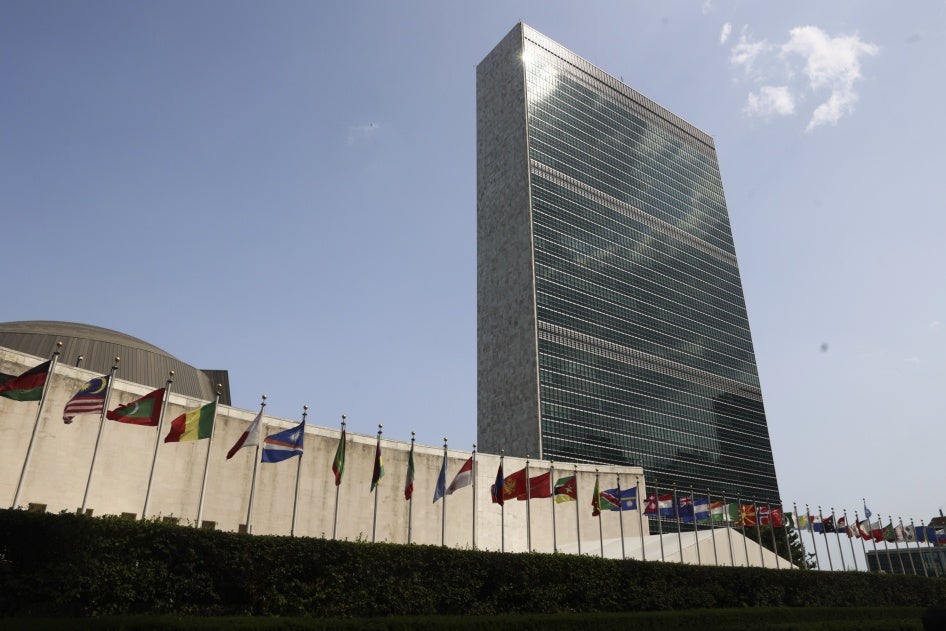
(New York) – UN member countries should work to align the emerging United Nations tax convention with international human rights law to achieve its objective of advancing sustainable development, seven human rights groups said today in a submission to the Intergovernmental Negotiating Committee. The submission proposes edits to the draft text to incorporate these standards and guidance into the draft convention.
The groups are Amnesty International; the Center for Economic and Social Rights; Dejusticia; the Global Initiative for Economic, Social, and Cultural Rights; Human Rights Watch; the Initiative for Human Rights in Fiscal Policy; and the Tax Justice Network.
“The current outdated and patchwork global tax system is driving an extreme concentration of wealth that is depriving most governments of money that could fund rights like health, education, and social security,” said Sarah Saadoun, senior advisor on economic inequality at Human Rights Watch said. “Aligning the tax convention with human rights is the best way to provide a strong foundation for a fairer global tax system that could let governments improve people’s lives.”
Negotiations for a first UN tax treaty began in 2025, with a draft to be submitted to the UN General Assembly in 2027. The United States withdrew during the first round of negotiations in February 2025, but dozens of other governments, including European Union members and other major economies, have been actively engaging in negotiations.
The countries agreed to make sustainable development the explicit objective of the new UN tax convention. Human rights can provide standards and guidance to help ensure that the convention achieves this objective. International human rights law requires governments to take steps, “to the maximum of [their] available resources,” to progressively deliver the full realization of economic, social and cultural rights—such as education, health care, and social security—both individually and through international cooperation and assistance. Practically speaking, the effective protection of other human rights depends on having adequate government resources as well.
Numerous UN human rights mechanisms have underscored that a fair international tax system is critical to any hopes of enabling governments to mobilize adequate domestic resources to fulfill human rights.
The debates at the heart of the treaty negotiations have enormous implications for rights. Governments lose about US $500 billion globally each year to tax abuse, according to the Tax Justice Network. The UN Tax Convention could help generate significant income for governments by, for example, curbing tax evasion and avoidance, preventing companies from shifting profits to tax havens, and giving governments the right to tax companies whose profits are unjustifiably put out of reach under current rules.
“Tax is one of the most powerful tools governments have to realise human rights”, said Sergio Chaparro, international policy and advocacy lead at the Tax Justice Network. “Global tax rules have restricted the ability of countries to serve broader aims such as the fulfillment of human rights. The UN tax convention offers a historic opportunity to change course.”
Governments would be able to mobilize significant new revenue under a fairer global tax system, which would vastly improve their ability to fund public services and social security systems, while reducing their reliance on taxes that disproportionately harm people with lower incomes, the groups said.
“Many of the same governments that claim to support human rights are fighting the hardest to maintain a tax system that deprives governments of the revenues they need to fulfill rights,” said Camila Barretto Maia, executive director of the Global Initiative for Economic, Social and Cultural Rights.
Research in countries such as Sri Lanka has shown that the global tax system undermines governments’ ability to fund human rights. Nearly half the world’s population—3.6 billion people—live in poverty, defined as less that $6.85 per day, and around the same number have no access to any social security benefits. More than half—4.6 billion people—still lack access to essential health services. Fixing the current tax system is critical to ensure universal support for these rights, the groups said.
“Human rights and fair tax cooperation must go hand in hand. Embedding human rights in the convention can strengthen the negotiations and help a global tax architecture that currently enables abuse and deprives governments of the resources needed to realise economic, social and cultural rights,” said Maria Ron Balsera, Executive Director of at the Center for Economic and Social Rights.
It is also essential to the realisation of civil and political rights. Anger over economic inequality and elite capture is fueling the rise of authoritarianism in some countries, and motivating protesters to go into the streets to demand change in others.
“At a time when international cooperation and assistance is needed more than ever,” said Riva Jalipa, researcher and advisor with Amnesty International, “The UN tax convention provides an historic opportunity for more transparency, accountability and the participation of states on an equal footing to rewrite a more equal global tax system.”